ARCHITECTURE

Independent assurance between approved AI design and production execution.

Resolve approved configuration, govern consequential actions and preserve connected evidence without replacing the AI stack.

REFERENCE ARCHITECTURE

Works alongside the customer stack.

Applications, orchestration, models, tools, data, CI/CD, identity and observability remain the customer's stack.
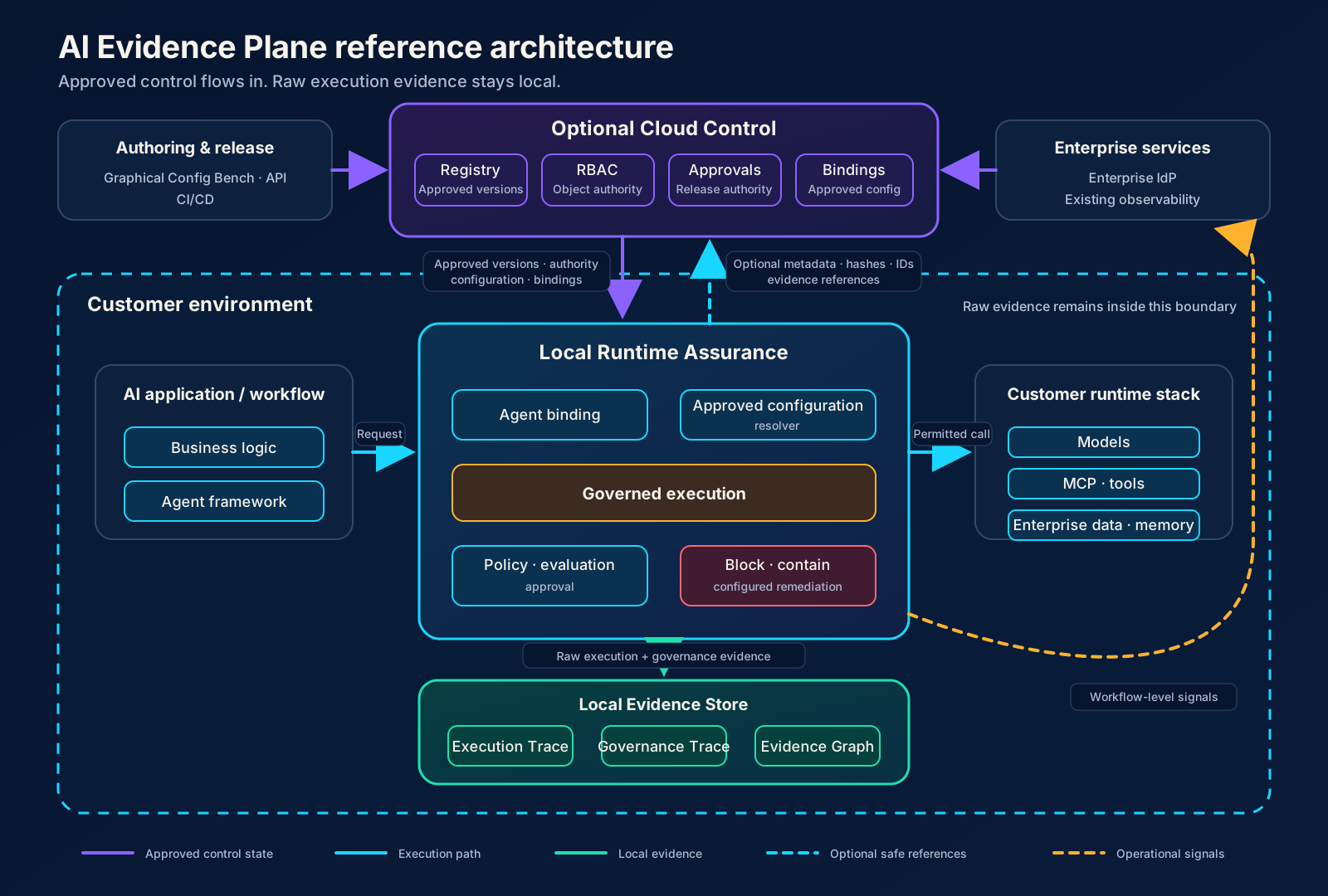
Reference architecture showing optional Cloud Control outside the customer environment, Local Runtime Assurance and Local Evidence Store inside the customer boundary, and controlled connections to applications, models, tools, data, identity and observability.
  1. Optional Cloud Control
  2. Customer environment
  3. AI application / workflow
  4. Local Runtime Assurance
  5. Models · tools · data
  6. Local Evidence Store
  7. Execution Trace · Governance Trace · Evidence Graph
View full reference architecture
Raw execution evidence remains inside the customer environment.

CUSTOMER BOUNDARY

Keep control and raw evidence close to execution.

Raw workflow evidence remains inside the customer environment. Approved metadata, hashes and references can optionally support central review.

Optional Cloud Control

Customer environment

AI application / workflow
Local Runtime Assurance
Governed execution
Local Evidence Store
Execution TraceGovernance TraceEvidence Graph

Raw evidence remains local

Approved control can enter the runtime assurance layer; raw evidence stays in the customer boundary.

CONNECTED ARCHITECTURE

One workflow instance connects design, execution and proof.

The architecture preserves the relationship between what was approved, what ran, why it was permitted and what outcome followed.

Approved design
Observed execution
Connected proof
Execution TraceGovernance TraceEvidence Graph
Workflow Instance ID
One workflow instance binds the approved design, observed execution and connected proof artifacts.

CLEAR RESPONSIBILITIES

Add assurance without rebuilding the AI stack.

AI Evidence Plane provides

  • Approved configuration at runtime
  • Governed consequential execution
  • Workflow-level operational context
  • Connected execution and governance evidence
  • Controlled remediation paths
  • Evidence-backed review

Your existing stack continues to provide

  • Application and business logic
  • Agent orchestration
  • Model inference
  • Enterprise tools and data
  • CI/CD
  • Infrastructure observability
  • Enterprise identity provider

DESIGN-PARTNER REVIEW

Bring one architecture. Leave with its control and evidence boundary.

Map one production workflow, decide where control runs, establish what remains local and define the evidence required to expand responsibly.

Discuss one workflow